|
Reflections 2026
Series 3
September 1
Academia VI: Queens College II – Spelling Lies!
Ethnic Neighborhoods: Kleindeutschland & German Yorkville - Aberystwyth
| | In the last posting, regarding Queens College I probably went overboard in listing the myriad offerings of the language departments today. My purpose was to show that certain problems I had back in the day have apparently been overcome. However, I will now feel freer to take the liberty to gripe about just what those earlier problems were.
When talking about my courses, mostly positively, I also said I would leave the three biggest topics until later, which is now.
MAJOR SUBJECT At Tech, my major was perfect: College Prep. That course of study got me into German, and provided other wonderful courses that I enjoyed. At Queens College, it would be ideal: I'd be a German major. That phrase turned out to be superficial, and not at all what I thought it would be. I wasn't really a German major, even if that's what it was called. My major turned out to be German Literature, which was not what I had been planning on.
Think about it openly. When you're learning a language, with it you need something to delve into involving that language. There are numerous possibilities. Extending language study with readings in linguistics (phonetics, phonemics, morphemics, and more—a "language person" not knowing the International Phonetic Alphabet is at a disadvantage); extending language study with readings in history (learning about the Wiener Kongress being the Congress of Vienna; learning that Karl der Große/Charles the Great was Charlemagne). Language plus cultural studies (cinema, TV, foods). While at first I wouldn't think of language plus science, it turns out that's just what we had done in Brooklyn Tech, where at the time, the two languages offered were specifically Scientific German and Scientific French. I discussed in 2025/7 how we learned about German scientists like Semmelweis and the Periodic Table of Elements.
There is another possibility, which for some reason has overwhelmingly taken over language study: language plus literature, even often referred to as Lang-Lit. It's certainly a valid option, but it's unfortunate that that's the only possibility offered so frequently. Many Language Departments are blatantly called Language & Literature Departments. At QC it was called the German Department at the time, but what was offered and taught was almost exclusively German Literature.
I remember arriving at QC and looking at the college catalog, where the German Department's course offerings were a list of periods of German Literature, such as Classicism, Romanticism, Realism, Sturm und Drang/Storm and Stress. I never fully understood that last term back in the day, nor do I today. Worse, I still couldn't care less. Why was I being forced into something I didn't care about?
I will say that the German Department was rather small, with only four professors. I don’t remember classes having more than 20-25 students. In retrospect, possibly some of them were just fulfilling a language requirement, or were there out of curiosity, to give German a try. I don't really know how many were German majors.
| | | | | | A student acquaintance in the department, also a German major, tho not yet a close friend, was the late Rita Bukenberger, later married as Rita Bell. I had the unusual experience of "meeting" her anew on three separate occasions over our lifetimes. More later. |
| | | | CLOUDS At this point, I'll get some steam off—just disregard the negativity, since all worked out well in the end. I'll get more positive again after these next points.
In my first couple of years at QC, I can say that the low point of my day was going to German class. I managed OK, tho obviously not spectacularly. I remember the sinking feeling when in class or on an exam the question about a character was asked: Was ist die Motivation? I couldn't care less what his motivation was. I wanted to study the words we were reading, and their history, and the culture.
For some reason, the name Hölderlin sticks in my mind. We learned about him, and yet I learned nothing. Looking him up now, I see he was a "key figure of German Romanticism". So was Novalis, another name that sticks in my memory. I'm sure they were all important, but I just didn't care. That you've probably never heard of either name is indicative of the specialized rabbit hole I unwillingly found myself in. Fortunately, in my later years at QC, I found my way out of this quagmire, so fear not.
Part of this experience involved what turned out to be my Lifetime Worst Academic Adventure, which I didn't discuss with anyone at the time, or since, so this will be a revelation. It started the first time I had to write a term paper for one of these German lit courses I hated. I don't remember if the topic was assigned, or chosen, but I had no more interest in it than I did in the course. Thus, I avoided it, and it went down to the night before the paper was due. Only with that pressure was I able to force myself to do it.
I went to my room in Hollis, took out my typewriter, and started typing. The paper had to be about three double-spaced pages in German, and it took all night. I did not write a draft copy—what I typed was what was to be turned in. I pulled an all-nighter, and got it done by morning. I don't remember the grade, but it was adequate. As far as I was concerned, I was writing garbage, and never kept it once graded and returned. I didn't burn the things, but I wish I had—that's how much I hated what I was doing.
Once that worked the first time, believe it or not, that adventure was repeated on purpose maybe 2-3 times more. Only with that overnight pressure could the sausage machine grind out that literary babble I so hated. Still, I must have been rather good at producing what I needed to get by. But it couldn't go on forever—it was only the first couple of years at QC, and then the problem was resolved.
SUNSHINE I'll now get back to the meager positive side of the situation. It wasn't all bad, so let's separate some wheat from that chaff. While we read excerpts from Schiller's Die Räuber/The Robbers, it left me cold. But then we read excerpts from Schiller's Wilhelm Tell, and the familiarity of the story drew me into what we were doing. Years later I traced the Tell story in Switzerland.
An entire course was dedicated to the two parts of Goethe's Faust and I still retain a copy of it. It's considered by many to be not only Goethe's major work, but also the greatest work of German literature. While I was not totally thrilled reading excerpts from it, I did enjoy tracing its story line when in Germany, particularly in Leipzig (more later). But the most positive was when we reached the 20C. I became interested in Bert Brecht, and later was pleased to play in Middlebury a very minor part (one line) in one of his plays, but wearing a magnificent costume.
And then there was Erich Maria Remarque's Im Westen nichts Neues, literally "In the West, Nothing New", but standardly translated as All Quiet on the Western Front. We surely touched on the novel in class, tho I don't remember reading excerpts from it. I got to know it by watching on late-night TV the famous American film version starring Lew Ayres made in 1930. As I'll point out later, a lot I know about literature was derived from film versions of the novels.
| | | | Mentors I said I held Dr Walter Bernard at Brooklyn Tech, who expertly introduced me to German, as a language mentor, and it strikes me on reflection that I was fortunate enough to have had an entire series of such language mentors, and one stands out at QC, Dr Harold Lenz (say LENTS), one of the four professors in the German department. I'll start with the first of three reasons I cite him. | | | | 1) Subject Matter He was very personable in the classroom. Lenz is an archaic word for spring[time], and if ever he was a few seconds late arriving to class, he announced his arrival with "Der Lenz ist da!" (Spring is here!) It amused me every time he played with the language. In addition, one of the courses I had with him was 20C Drama & Poetry, which included Brecht and others that I really got to enjoy. I remember Dr Lenz introducing Christian Morgenstern as well as much of what follows, which helped to turn me around as to my feelings on being forced to be a lit major. Most English speakers have never heard of him because, while some of his work can be translated, much of what he wrote was language-specific and cannot be translated, which is one reason I grew to like his work. We'll illustrate both possibilities.
Morgenstern's dates are 1871-1914. He suffered from tuberculosis his whole life, which killed him at age 42. Actually, I wrote about one of Morgenstern's poems in 2007/12, where the theme was translation. I'll repeat it here, edited. I envision this poem as a comment on local versus long-distance travel.
| | | | | | WINDGESPRÄCH WIND TALK
"Hast nie die Welt gesehn? "Have [you] ever seen the world?
Hammerfest—Wien—Athen?" Hammerfest—Vienna—Athens?"
"Nein, ich kenne nur dies Tal, "No, I only know this valley,
bin nur so ein Lokalwind— am just sort of a local wind—
kennst du Kuntzens Tanzsaal?" do you know Kuntz’s Dancehall?"
"Nein, Kind. "No, child.
Servus! Muss davon! Bye! Gotta go!
Köln—Paris—Lissabon." Cologne—Paris—Lisbon."
|
| | | | Note the unusual rhyme pattern of the original: AA BCB CDD.
With some effort and several non-disastrous changes, I found this to be translatable to English. This is my result.
| | | | | | WIND TALK
"You mean you never knew
Berlin—Rome—Timbuktu?"
"No, I only know these woods,
I’m, like, just a local wind—
been to Johnson’s Dry Goods?"
"No, kid.
Bye, now! Gotta fly!
Madrid—Trieste—Shanghai."
|
| | | | 1) A number of changes were necessary to get it to rhyme, and to rhyme in the pattern of the original. The only poor rhyme is C/C wind/kid.
2) The syllables-per-line pattern follows the original exactly: 6,6 / 7,7,6 / 2,5,6.
3) Both groups of cities in the original line up geographically in a roughly straight line on the map, following the route the wind could take, and so do the ones I’ve chosen. The original uses just cities in Europe, but I have extended the outlook to Africa and Asia.
4) Senior Wind talks down to Junior Wind—that’s the whole point here--so I have Senior calling Junior “kid”, since "child" sounds dated here. Also, Junior uses "like" in typical teenage fashion.
I've translated over time several poems and songs on these postings, but I never tried to rhyme the translations, which seems nearly impossible and usually would grossly distort the original. But here I managed to, and I'm pleased with the result. Quality translation is not secretarial work. It’s an art, which is why today the National Translation Award is given to quality work in both prose and poetry.
I want to continue to cite Morgenstern as a very obvious key to 20C German literature that I've grown to like, as presented by Dr Lenz. Oddly, while I don't usually like the abstract and certainly not the surreal, much of Morgenstern is just that, surreal, and I love it.
Notable is DAS KNIE (The Knee—pronounce the K). Much abridged, it starts out: Ein Knie geht einsam durch die Welt A knee goes thru the world all by itself. -- How surreal can you get?) The second verse is: Im Kriege ward einmal ein Mann / erschossen um und um. / Das Knie allein blieb unverletzt-- / Als wär's ein Heiligtum. In a war once, a man was / shot thru and thru. / Only his knee remained unharmed-- / As though it were a holy relic. -- This bit of Morgenstern reminds of the antiwar theme of Remarque's "All Quiet".
If you want surreal, try DER LATTENZAUN (The Picket Fence). Es war einmal ein Lattenzaun / mit Zwischenraum hindurchzuschaun. Once upon a time there was a picket fence / with space between [the pickets] to peer thru.
Ein Architekt, der dieses sah / stand eines Abends plötzlich da -- An architect who saw this / was suddenly standing there one evening –
und nahm den Zwischenraum heraus / und baute draus ein grosses Haus.
and took out the space between / and built from it a big house.
Der Zaun indessen stand ganz dumm, / mit Latten ohne was herum. Meanwhile the fence stood there looking very dumb, / with pickets having nothing around them. . . . --Then officials looked into the matter.
Der Architekt jedoch entfloh / nach Afri- od- Ameriko. The architect however fled / to Afri- or Americo. -- Look at what Morgenstern did to get a rhyme! He took Afrika and Amerika, blended them, altering the As to an O. He also lopped off the last syllable of oder. Crazy fun, and untranslatable.
Another surreal one (edited slightly) is DER SEUFZER (The Sigh). Ein Seufzer lief Schlittschuh auf nächtlichem Eis / und träumte von Liebe und Freude. A sigh went skating on night-time ice / dreaming of love and happiness. . . .
Der Seufzer dacht an ein Maidelein / und blieb erglühend stehen. / Da schmolz die Eisbahn unter ihm ein -- / und er sank -- und ward nimmer gesehen. The sigh thought about a young girl / and came to a stop all aglow. / So the ice under him melted -- / and he sank –- and was never seen again. -- I suppose this makes it a surreal love poem!
I have two more favorites, and they not only are surreal, they combine it with language usage. First we have DAS ÄSTHETISCHE WIESEL (The Esthetic Weasel), edited slightly.
| | | | | | Ein Wiesel A weasel
saß auf einem Kiesel was sitting on a pebble
inmitten Bachgeriesel. in the middle of a babbling brook.
Wisst ihr weshalb? . . . Do you know why? . . .
|
| | | | So let's see what made this weasel esthetic. | | | | | | Das raffinier— The refined--
te Tier animal
tat's um des Reimes willen. did it because of the rhyme.
|
| | | | The last line tells us the weasel was refined because he was a poet, creating rhymes. Is this poem translatable? I found English rhymes for "weasel": "easel, diesel". But there's no way to translate the two lines before the last. Morgenstern has taken a four-syllable word, raffinierte and put the last syllable by itself on the next line. That allowed the -IER rhyme to work, and also alliterated the T/T. But how do you do that in another language? You don't.
I have one more Morgenstern I like that goes "all the way" into German grammar, which means it seemingly cannot be translated. However, if I explain it to non-German speakers, I think everyone can enjoy it. It's called DER WERWOLF [W=V both times] (The Werewolf), so even the title gets us off into the surreal. First we can point out that the word has a mixed derivation. The last part is purely Germanic, but the first part is derived from the Latin word vir (man, as in "virile"), so the combination "man-wolf" does make sense.
However, wer (rhymes with "fair") happens to also be the German word for "who", so Morgenstern uses the conceit that a Werwolf might be a "who-wolf", and runs with it. Also, remember that verbs get conjugated and nouns and pronouns get declined; German has a single word to do both: beugen. Let's take a look, again, edited for length.
| | | | | | Ein Werwolf eines nachts entwich One night, a werwolf ran away
Von Weib und Kind und sich begab from [his] wife and child and made his way
An eines Dorfschullehrers Grab to the grave of a village schoolteacher
Und bat ihn: Bitte, beuge mich! . . . And asked him: Please, decline me! . . .
|
| | | | If it's not creepy enough, this werewolf has a wife and child. Morgenstern goes on to satirize the experience we all had in elementary school where we were taught the simplest grammar. Thus the authority here is a village schoolteacher, perhaps a bit pompous. And of course, he's dead. Skipping ahead a bit, he pontificates: | | | | | | "Der Werwolf", sprach der gute Mann, "Der Werwolf" spoke the good man,
"des Weswolfs, Genitiv sodann, "des Weswolfs, genitive after that,
dem Wemwolf, Dativ, wie man's nennt, dem Wemwolf, dative, as it's called,
den Wenwolf, damit hat's ein End." den Wenwolf, that's the end of it."
|
| | | | This is delightfully ridiculous—which is Morgenstern's point. If you decline "who" in English, you get the possessive case form "whose" and the dying objective case form "whom", used in English today, not practically, but just to impress. If "werewolf" did indeed mean "who-wolf", it's like saying "whose-wolf" and "whom-wolf". Thus, Morgenstern alters "der Wer-" to "des Wes-" in the possessive (genitive) case, a form that is almost completely dead in German today; then to "dem Wem-" for an indirect object (dative) form, and "den Wen-" for a direct object form in the (unnamed) accusative case. Absolutely crazy. | | | | | | Dem Werwolf schmeichelten die Fälle, The cases flattered the werewolf,
er rollte seine Augenbälle. he rolled his eyeballs.
"Indessen", bat er, "füge doch "So then" he asked "why not add
zur Einzahl auch die Mehrzahl noch." to the singular, the plural as well.
|
| | | | Morgenstern is great with his rhymes, such as Fälle/Bälle (fellə, bellə). Then he does something clever with his vocabulary. Most languages have more than one word to say something, the alternate often being more formal, such as English "ask, request". German has Germanic [die] Einzahl, [die] Mehrzahl ("one-number, more-number") as well as the more erudite Latin [der] Singular, [der] Plural. Morgenstern has the werewolf ask his question using the more everyday terms. | | | | | | Der Dorfschulmeister aber musste But the village schoolmaster had to
gestehn, dass er von ihr nichts wusste. confess that he knew nothing about it.
Zwar Wölfe gäb's in großer Schar, True, wolves may exist in great numbers
doch "Wer" gäb's nur im Singular. but "wer" only exists in the singular.
|
| | | | The schoolmaster takes the opportunity to quite correctly pontificate on the grammatical point. But while the lowly werewolf used simpler terms, he replies more loftily using latinate "Singular", which, happily also rhymes. | | | | | | Der Wolf erhob sich tränenblind— The wolf got up, blind with tears--
er hatte ja doch Weib und Kind! after all, he had –[a] wife and child!
Doch da er kein Gelehrer eben, But since he [was] in no way a scholar,
so schied er dankend und ergeben. he left, thankful but humbled.
|
| | | | Our protagonist is in no way a scholar, nor were we when we first heard about grammar in elementary school. But as we look over several languages, we can add to this.
It's perfectly true, German wer and English "who" have no plural form. Nor does French qui, Italian chi (both pronounced KI), nor Russian кто (KTO). But Spanish does! It has both quién, quiénes (KYEN, KYEN.es), and it works quite simply. You choose, depending on the answer you expect. If one guy comes around the corner, you ask ¿Quién es? – Es Pedro.. But if two guys come around the corner, you ask ¿Quiénes son? – Son Pedro y Juan.
Thus, if you translate the poem into Spanish, you have an additional barrier, because Spanish speakers are quite used to the word having a plural.
Up until now, I would have called translating this poem into any other language as being impossible, but then I came across something online showing how clever a translator can be. An author named Andrew Gross apparently looked at the English spelling of "werewolf" and saw in its first syllable a form of the verb "to be", ([we] were), tho pronounced differently. Thus, Gross took the word and "conjugated" it further, starting out:
| | | | | | "Well, 'Werewolf' is your plural past,
While 'Waswolf' is singularly cast:
There’s 'Amwolf' too, the present tense,
And 'Iswolf,' 'Arewolf' in this same sense."
|
| | | | Gross has the crisis develop when the werewolf wants to hear what his future is. Edited, he's told: "A 'Will-be-wolf?' It's just too long . . . I’m sorry, but you have no future." I find it all very clever.
Curious, I researched Andrew Gross and found that he's a New York Times bestselling author, and, among many other works, he collaborated with James Patterson in 2005 on his Women's Murder Club series, specifically the second and third novels. I believe I read all 25 novels in that series years ago, so I see I'm back to someone I apparently "met" in the past. It's fun to know Gross also dabbled with Morgenstern. Small world.
I want to again make it clear that I'm using Dr Lenz's presentation of Morgenstern to represent the early 20C German authors that got me interested in the subject. But Morgenstern wasn't the first to get involved in Nonsensliteratur. Back in the mid 19C there was Edward Lear and Lewis Carroll, whose Jabberwocky is considered one of the great nonsense poems in English. It starts: 'Twas brillig, and the slithy toves / Did gyre and gimble in the wabe; / All mimsy were the borogoves, / And the mome raths outgrabe. I remember learning in a linguistics class that, tho the words have no meaning, they are all possible. Each word conforms to English structure, and it's easy to see which words are verbs, adjectives, or nouns. The only thing lacking is meaning.
I've also come across an anonymous poem in German which is worth mentioning to further illustrate nonsense literature in the German sphere. Its origins are unclear, but it seems to stem out of the late 19C. It consists of one oxymoron after another. The first verse is: Dunkel war’s, der Mond schien helle, / schneebedeckt die grüne Flur, / als ein Wagen blitzesschnelle, / langsam um die Ecke fuhr.
. / "Dark it was, the moon shone brightly / snow-covered [was] the green meadow, / when a car, fast as lightning, / came slowly around the corner."
BRECHT: The only German term paper from QC that I've kept was one from 29 May 1959. Given the way I wrote those term papers at the last moment, it must have been decent, since Dr Lenz gave me an A on it. He wrote this comment, which has stayed with me, and which I can quote from memory: Ich gratuliere Ihnen zum Durchbruch zu einem anständigen deutschen Stil! Gute Arbeit! / "I congratulate you on your breakthru to a respectable German style! Good work!"
I might have thought he wrote that after my first summer at Middlebury, but that's not so. He wrote that in May of the same year that, a month later, I went to Middlebury in June. So I must have learned something even before Middlebury!
But the mind plays tricks, especially after 67 years. I just reread that paper and find it was a comparison between a certain Brecht play and one of another author. I discussed Brecht's theories, which familiarized me with him before we put on a play of his at Middlebury. But before I reread it, I remembered it entirely differently.
My recollection was that the paper was exclusively about that certain Brecht play, not comparing it with another author's play at all. This is that play: Furcht und Elend des Dritten Reiches / Fear and Misery of the Third Reich. Unfortunately, that play is also known in English by the horrible title "The Private lives of the Master Race". It premiered in Paris in 1938 and is the first of Brecht's openly anti-Nazi works. It consists of a series of 24 playlets portraying the Nazi Germany of the 1930s for what it was. I remember taking note at the time particularly the 9th playlet, Die jüdische Frau / The Jewish Wife, about a woman who agonizes about leaving her non-Jewish husband—and Germany—to save his career at a clinic.
Tho I must have read this playlet thoroughly, I actually said little about in on the term paper, even tho I remember the paper being exclusively about it. So much for recollections.
| | | | 2) Another Second Language I said there were three reasons for which I'm grateful to Dr Lenz. The second is that he got me started in another second language. One may think that, after I started German, I might have been ready to plunge into others, but that wasn't the case. Early on, I had no plans to go further with the many languages I eventually ended up studying, some thoroughly, some superficially. And the reason Dr Lenz got me started was not for the love of learning, but for a simple practical reason.
I must have met with him as my College Advisor even before I graduated from high school since I started taking two languages from Day One at QC and continued for all four years there. He asked me what my career plans were, and I had none. I just liked language. Now we all know that some fields lead directly into careers: and engineering major goes into engineering, and chemistry major becomes a chemist. But what happens to those who major in philosophy, art, English—or languages? He pointed out what I really already knew. Either a German major teaches German—which I did at John Jay in Westchester for 28 years, 1964-1992, with Spanish, or translates, which I did for American Express on Lower Broadway, for the year 1992-1993, with French.
But either way, one second language is not enough, and, tho he didn't specify German, he might not have said that if my major were French or Spanish, widely taught languages. Teachers of German, Italian, Russian, or other less-taught languages are really the ones who need the back-up of another second language.
| | | | | | That wasn't always the case with German. At the turn of the 20C, German was the most popular modern language taught in the US. That's why, when Dr Lillian Stroebe of Vassar founded the first Middlebury Summer Language School, the German School was the obvious choice, in 1915. For a quick three-paragraph review of that, see 2019/2 Ctrl-F Stroebe. |
| | | | So his advice was purely practical, not academic. But the balance of his advice put me on an unexpected path. He said that French is a common addition for German majors, but if I had Spanish along with German, I'd have something unique to offer a potential employer. At the time, I didn't have a preference (tho after that next summer in Paris, I did like French), and it was always in my nature, especially early on, to follow authority figures, so I went with Spanish and signed up for what became four years of Spanish classes at QC. | | | | | | Going thru old papers in my files recently, I found the ad telling me about the opening at John Jay. As it turns out, they wanted someone who could teach German, along with either French or Spanish. So it's ironic—French would have worked. But then, what would have pushed me into Spanish as extensively as I went? |
| | | | HEAR/SPEAK, THEN READ/WRITE It's fundamental to the thinking of modern language learning that hearing and speaking a language comes first, then comes reading and writing it. We learn to (passively) speak our native language first as toddlers imitating family, then are sat down to (actively) learn to read the written version of the language. Because of that sequence, it tends to be the conception of the lay public that language is a written phenomenon, period, rather than a recorded reflection of "speaking a language".
I am so appreciative that Dr Bernard at Tech, ahead of his time, started us out speaking sentences, then later working with written German. I've done that sequence with all the languages I've studied, even superficially studied. With one exception, and that was not up to me. While I do not remember the first day of Spanish class at QC, I'm quite sure we were told to open our books and start reading. Thus, it's the only language I learned "backwards". Fortunately, if one has a good language ear, one can overcome that, but many learners never do, and remain with an English-language accent in their new language.
As for Spanish, try this: say the English words "no; dose; trace". Now attempt the Spanish words no; dos; tres. They are of course extremely similar. But they are not the same. It's very possible you're pronouncing the Spanish words with an English-language accent.
People often characterize languages (unfairly) as "nasal" or "gutteral". English can be correctly characterized as a language of vowel off-glides. Few if any English stressed vowels are simple or "pure"—they usually come with an off-glide in the form of U or Y. The word "no", for instance is pronounced NOu. Someone learning English who wants a good accent has to learn to add off-glides. On the other hand, someone learning another language, such as Spanish, has to avoid adding any off-glide on Spanish no, making it sound a little clipped to the English ear—but accurate. Thus "dose" is really DOuS in English, but don't do that for Spanish dos. It's even more extreme with "trace". In English, T before R becomes Ch, so it's ChREiS. Don't do either of those things to Spanish tres. You have to hear these differences to learn to speak them. Afterward, you can read (and write) the Spanish word.
Ask any educated person about vowels in English and they'll babble off "AEIOU and sometimes Y", not being sure just when Y is a vowel. That's all nonsense. Those are the LETTERS used to represent the myriad of English vowels, with the most common vowel being, by far, the very lax central vowel schwa (ə). The word ərenə (arena) both starts and ends with a schwa.
One more shocker. A very common preposition in English is UV, but it's hard to recognize because of the crazy spelling, which is "of". That the letter O is used for the vowel U, happens elsewhere (other, mother, brother), but it's unique to this word that V should be spelled F. Swedish has virtually the same word, but has the sense to spell it av: in Swedish, "parts of Europe" is delar av Europa.
Thus I ask you to learn this mantra: SPELLING LIES!! That remains true at least until one learns the tricks of spelling. Because of this, be wary of what you see in written form, since what people SAY is language, not some written form with inaccuracies. Let's try this little experiment. What's your reaction to this statement?: SPANISH HAS NO V.
I'm sure you'll bristle at the thought. What about Venezuela, Valencia, Bolivia, Feliz Navidad? If that's your reaction, you're proving my point. You're going by the alphabet, and envisioning the LETTER V. But spelling lies, and the alphabet tells you far less about the language than you imagine.
Since English and other languages STOLE their alphabets from the Latin alphabet, let's start with Latin. You'd think its alphabet was custom-made for Latin, and it pretty much was. But the Romans had great admiration for Greek culture and they borrowed a form of the word γυμνάσιο / gymnásio "gymnasium", which included in second place the letter Upsilon, whose upper case form looks like a Y. In Classical Greek it was pronounced like Ü (Modern Greek like I). Even tho the Romans already had an I, they adopted Upsilon (Y) as an alternate spelling. This is one example of standard spelling being given an extra task, two letters (I, Y) for one sound. This still reflects in modern English spelling: you hear SIS- and have to be aware that, if the word is Germanic, you write SIS[ter], but if it's Greek, you write SYS[tem].
| | | | | | This I/Y combo appears in the names in Latinate languages for the letter Y. French calls it "i grec", Spanish "i griega" Romanian "igrec", all indicating knowledge that Y is the "Greek I'. |
| | | | As twisted as standard spelling is in English, the lay public swears by it and takes it for perfection itself. I knew someone who pushed herself to pronounce KU.brd as KUP.brd because its spelling was "cupboard". She also tried to go out of the way to pronounce KAM.bl (as in the soup) as KAMP.bl because it's spelled "Campbell". She was unaware that the P had left both words long ago, despite the lying spelling still showing them.
People in a teaching situation have a further duty to learn more about sounds and spelling. I remember a teacher in elementary school who came across a pupil having trouble pronouncing "th" as in "think", which I'll write as Theta (θ) "θink". I clearly remember her actually telling him to "pronounce T and H together". She had no idea what she was talking about. T is made with the tongue-tip against the roof of the mouth and H is made in the throat. But θ is made with the tongue-tip on the upper teeth. It was dreadful advice she gave him.
Keeping sounds (phonemes) and spelling apart is a huge topic, but I want to try one more experiment. In English, how are regular plurals formed? I suspect most people would say "add an -S", then modify that by adding "after a sibilant (a hissing sound like S, Z, SH, CH, J [DGE], ZH) make it an –ES". Was that your answer? If so, you described the spelling rules, and, as we know, spelling lies.
First, organizationally, one puts the oddball case first, so after sibilants, you add –ƏZ: BUS.əz, QUIZ.əz, BUSH.əz, CHURCH.əz, BRIDG.əz, mi.RA.zhəz (mirages).
Second, after all voiced sounds (all vowels plus voiced consonants), you add a –Z: SO.faz, CAF-éz, bi.KI.niz, pi.A.noz, MEN.yuz, BOYZ; BIBZ, FRENDZ (friends), DOGZ, PIGZ, etc.
Third, after all voiceless consonants, the Z goes voiceless as well to an S: CAPS, CATS, PAΘS (paths), PAKS (packs), CLIFS (cliffs), etc.
People speak cavalierly of "S plurals" in English. It would seem that the reality is that English has varieties of "Z plurals". But this is all to illustrate a point. If someone learning English just starts by listening to a recording or to a live teacher, this all comes naturally, given some degree of having a "good ear".
Standard spelling has taken on other duties, that of maintaining old forms. LAM is spelled "lamb". It derives from Proto-Germanic *lambaz. But the word shortened, to the point that even the B was lost as of the 13C. Yet that B is maintained in modern spelling as a so-called "silent letter" a shameful term that the lay public doesn't recognize for the oxymoron that it is.
Then there are the do-gooders. C 1300, the word "dette" was standard for money owed. They during the 16C, pontificating scholars wanted to show that the word had derived from Latin debitum, so they had the gall to reinsert a "silent B" into the word to end up with the mendacious spelling "debt". Similarly do-gooders added a "silent P" to "receipt" and a "silent S" to "island", just for looks, in an attempt to show historical connections. You will note I have strong feelings as to what we've allowed to happen to spelling.
When it comes to other languages, if one is naïve as to how their spellings work, one will make mistakes. I think of people who see Italian "maraschino [cherry]". That spelling follows very specific rules in Italian, which go over the head of the naïve. They mistakenly see the German spelling SCH and say ma.ra.SHI.no instead of the standard ma.ra.SKI.no. This also happens with "bruschetta", which appears as bru.SHET.ta instead of bru.SKET.ta.
The lay public maintains the folly that standard spelling always corresponds to what we say, and vice versa. But does anyone really think one should start out learning a new language based on mendacious, misleading spelling?
Let's try one more thing. I refer to the major German news magazine Der Spiegel. How do you say the name?
I think most people are aware that German words starting in SP- and ST—are code for SCHP- and SCHT-, so one would say *Schpiegel and *Schtuttgart, despite the historic spelling, just like Schnee (snow), schlafen (sleep), schwimmen (swim), schmieren (smear), Schrei (scream). All these others actually also underwent the spelling change after the pronunciation shifted (which SP- and ST- did not). But beyond that, I'm sure everyone would have trouble with the first word, in varying degrees.
On YouTube I watched a video where the speaker came across der and foolishly rhymed it with "burr". That's beyond the pale. However, most English speakers would rhyme it with "dare", which is an acceptable Anglicization. But that's not sufficient if you're trying to learn the language well.
Here's the nitty-gritty. Most German monosyllables that merely visually end in a written R actually end in a weak A [except if the vowel is already an A: war (was) is VAR]. Thus Ohr (ear) is O.a, Uhr (clock) is U.a, wir (we) is VI.a, für (for) is FÜ.a, hör! (hear!) is HÖ.a. Thus, der is DÉ.a (É as in "café"). So if you're trying to learn German, do call the magazine DÉ.a Schpiegel.
When learning a language, in the beginning, you cannot trust the spelling. If the word is not irregular, it probably follows spelling patterns in the new language you're unaware of. Thus, start out with either recordings or a live teacher if you want to do it right.
Now let's get back to that seemingly outrageous statement, that Spanish has no V. Maybe you now realize that the Spanish ALPHABET has the LETTER V, but the language itself has lost the V it once had. How can that happen? It's simple if you know a little about phonetics and how sounds work.
It's all about the lower lip. Touch it to the upper LIP, push out a puff of air with some sound, and you get a B. Spanish has always had a B. Now touch it to your upper TEETH and a stream of air with some sound will give an (English) V. Old Spanish once had this, since Latin had it. But in the 17C, it apparently became fashionable to move the lower lip forward, and all former Vs joined the Bs that had been there all along. In other words, whenever you see a WRITTEN V in Spanish, it's a B in disguise.
When native Spanish speakers are learning to write their language, they quickly catch on that when they hear Barcelona, they write Barcelona, but when they hear Balencia (down the coast), they have to write Valencia. It's a repeat of the Romans and their I and Y. And despite the spelling, they also say Benezuela.
| | | | | | For full disclosure, there's one more point we can add. The B sound, whether spelled V or B, is slightly different between vowels. The lips do not quite close and the airflow does not stop. This variation reminds you of a W. The phonetic symbol for this sound is the Greek lower-case Beta (β). Thus nave (nave) is naβe, nube (cloud) is nuβe, [feliz] navidad is naβidad. You find both in Bolivia: bo.LI.βi.a.
Here's one more craziness. The name of the letter B is bé and the name of the letter V is bé. The names are the same! Spanish speakers, when necessary, make the distinction this way: B is "bé de burro" and V is "bé de vaca (say BA.ka)" using a burro and cow to tell the difference.
|
| | | | Now I've just gone thru a detailed history of the V in Spanish. But it's not necessary to know it if you start studying Spanish with a recording or live teacher and just imitate what you HEAR when you SPEAK. With a good ear, you'll do well. But can you get that if you start a course by opening a book and reading? Spelling lies.
It's a bit difficult for me to think back, but I believe I learned Spanish with an English V, and kept on speaking that way for quite a while, until I learned better and dropped that bit of my English-language accent. When learning a language, do yourself a favor and: Caveat emptor!
| | | | 3) Blending in another College The third thing I'm grateful to Dr Lenz for, and the main reason I consider him the second mentor of my language career, is that he was the one who came to my rescue and blended in a second college to QC to strengthen my language abilities as an undergraduate. In that way, my last two years at QC were enriched by summer work elsewhere.
I was fully frustrated by getting so little of language proper in my language study and having classical literature, which was not my cup of tea, stuffed down my throat. It's fine for those who want it, but it wasn't the aspect of language study I wanted to concentrate on, tho it was the majority of what I was getting. In what might have been that same meeting in his office after he'd congratulated me on my term paper of 29 May 1959, I nevertheless expressed my dissatisfaction with my classes as being far to concentrated on classical literature and not enough on language study proper. I remember exactly what happened next. Dr Lenz leaned back in his chair and said "Well, there's this little college in Vermont . . . " and then he told me about Middlebury.
It was the perfect linkage. He apparently had taught in Middlebury's German Summer School in the past, so he knew exactly what it was all about, how well it worked, and how it was exactly what I needed. This was a major turning point in my career.
I'll discuss Middlebury in a later posting, but for now let me explain how I initially blended work there into my undergraduate studies. Middlebury's summer language schools are all on the graduate level if you want Middlebury credit, but they accept undergraduates who want to transfer that credit to an undergraduate school like QC. I signed up immediately for their German School that very summer, 1959, and for their Spanish School in 1960. Thus, for my final time as an undergraduate, I consider myself having the undergraduate benefits of both QC and Middlebury.
Let me show that overlap. I will remind that my cohort remained on the January-to-January schedule at QC. We were those that had had 9th grade in Junior High, where Tech had additional requirements for 9th grade, so six Tech semesters became seven for us. Thus we never had a feeling in Tech about subdivisions like a "sophomore year". This spilled over for me in QC. I never felt myself to be a freshman-sophomore-junior-senior. I suppose I just can say that I ran by the calendar years, 1957-8-9-1960, graduating from QC in January 1961.
Then, to get myself on a more normal academic schedule for graduate study, I spent Spring 1961 working on Wall Street as a clerk for an odd-lot brokerage house, DeCoppet & Doremus.
Let's back up a bit. The "Concentration" offered me in German, which, without any choice, I did take, were these courses: Rationalism and Storm & Stress; Ger Classicism; Contemp Ger Drama & Poetry; Contemp Ger Prose Lit; Ger Romanticism, Ger Realism; Goethe's Faust. All that, while I wanted to know more about customs, history, history of the language, phonetics, and so on, and wanted practical practice in speaking and writing the language. There was a course listed in the catalog called Conversation & Composition, but it was never offered in my four years at QC.
Spanish classes beyond beginning ones moved into Readings in Lat Am Lit, Classical Span Lit; Span Lit of the 19-20C.
| | | | | | There were good times. I mentioned Brecht and that term paper. It was fun reading Schiller's Wilhelm Tell, and I still have both volumes of Faust from that course, tho I got deeper into it at Middlebury. The Spanish classes also moved into literature, and I did enjoy it when we read excerpts of Don Quixote. More later.
I never got to take Romance 61: Intro to Romance Linguistics, tho I think I've worked out a lot on that topic since then on my own. I have to smile when I remember taking Commercial & Technical Spanish and learned the lengthy, flowery closings then used on business letters, where the equivalent of "Sincerely yours" could take a paragraph.
|
| | | | In my four years at QC, in addition to regular coursework, here's a snapshot of language courses I took during the Spring and Fall semesters.
1957: Spring: Mod Ger Reading & Speaking (I do not remember this, and doubt it did much good), Span 01; Summer: trip to Europe with SD, got totally tongue-tied with his Vienna relatives; Fall: 19C Ger Lit, Span 02
1958: Spring: 18C Ger Lit, Span 03; Summer: took courses at QC (at no cost) to get ahead; Fall: Ger Rationalism and Storm & Stress; Readings in Lat Am Lit
1959: Spring: Ger Classicism, Contemp Ger Drama & Poetry, Readings in Classical Span Lit; Summer: 3 Ger courses at Middlebury over six weeks: Practical Phonetics, Oral Practice, Composition & Grammar Review (yay!); Fall: Ger Romanticism, Contemp Ger Prose Lit, 19-20C Span Lit
1960: Spring: Ger Realism; a fun English course called "English Language"; Summer: 3 Span courses at Middlebury over six weeks: Phonetics, Advanced Grammar, Oral Work & Self-Expression in Span (yay!); Fall: Goethe's Faust; Commercial & Technical Span; plus two English courses: Modern English Grammar & Usage, Phonetics of the Eng Lang.
In all fairness to QC, I was enthusiastic about certain of these courses, including those English ones and Faust and Don Quixote. But it was the injection into my undergraduate work of those two summers at Middlebury that really inflated my balloon. But as to most of those German literature courses, while I remember names like Lessing, Hölderlin, Heine, and Kleist, don't ask me to place them in the proper periods of literature. And since the courses were rotated out of chronological order, I'm not sure which periods come before or after others. I remember things about math and physics, which I heartily enjoyed, better than I remember things that I didn't. But for now, that's all water under the bridge.
| | | | Voluntary Studies There are university students who take more responsibility for their course of study and those who take less. Back in high school, there may have been the feeling that "if he didn't teach it, he can't put it on the final exam!", and this sentiment leaks over during college study: "the establishment is responsible for teaching me". Other students may realize there are holes in what they know about their major subject and go out of their way to make sure they find a way to fill them: "I am responsible for what I learn and end up knowing." Over time, I didn't see how this affected me, but now I see it very clearly, and I will cite two things: French and "Library 400s".
FRENCH: I was working on German and Spanish, and at one point, I decided I should know French. I don't know when, but I might guess it was after the Summer 1957 trip to Europe and how I was so effected by being in France, my first non-English-speaking country. For instance, I remember that Gitanes billboard saying Avec ou sans filtre and, not knowing French, being thrilled at understanding it from context. Maybe there was some residual feeling of loss at not having chosen French at Brooklyn Tech, the only other language besides German offered at the time. I remember going to a bookstore, maybe the QC bookstore, and finding this large-sized blue book on Beginning French. The clincher on choosing this book was that it came with two 45-rpm records, one each inside the front and back covers, which corresponded to the introduction to each chapter. I already knew that the spoken language comes first, since Spelling Lies, and should be secondary. I remember being in my room in Hollis and playing the records as I studied my third Second Language totally on my own. But I never thought of it as a Voluntary Study, just as some fun I wanted to do.
Thus I never took a French course, not at Tech, not at QC, not at Middlebury. A decade after Mainz, Beverly and I had a joint sabbatical, and one thing we did traveling thru Europe in 1971 was stop in Pau (say PO) in southwestern France and take a three-week advanced-level French course, which I really enjoyed. Then when we went back to Middlebury for our doctoral studies in the late '70s, I chose French along with German for my two-language requirement, largely because German and French were her two Second Languages (she learned Spanish later) and we wanted to be coordinated. More about Pau and the rest later.
| | | | | | While my learning sequence was German-Spanish-French, I usually consider my Second Languages in the sequence German-French-Spanish. This is nothing against Spanish—we enjoyed living in Málaga (MA.la.ga) in southern Spain and studied Advanced Spanish for two months in the summer of 1990, the longest time abroad after the Mainz year. However, I will say I'm far more enthusiastic about Spain than Latin America and speak Castilian Spanish whenever in Spain, tho it was practical to use Latin American Spanish while teaching. |
| | | | LIBRARY JOB/400s Outside of class time, I found little to do at QC during the day, and did not look forward to the two bus rides back home to Hollis. At one point I decided to take a job in what was then Klapper Library, and ended up working I think daily for an hour in the late afternoon. I worked in the Current Circulation area for Ken Freyer, who wasn't that much older than I was. Ken knew I was studying French on my own, and when I graduated, he gifted me a French-English dictionary, which he inscribed "May you never have to say 'Pardon my French'."
I mostly shelved the new books, which were kept separately while they were still new. And knowledge rubbed off—I think I learned who Ayn Rand was while I was shelving new books. But most of all I remember being delighted when I discovered what was then a new book, Mister Pepys of Seething Lane (Pepys rhymes with "peeps"). I see now it was published in 1957 and is by Cecil Abernethy. It's a fascinating narrative based on, and summarizing, Pepys' voluminous diaries. Years later, I found it again for Beverly to read, and when in London, we walked around Pepys' area, the center of the Great Fire of 1666 that Pepys had described in the book.
But after work, still in no hurry to go home, I went into the main part of the library to browse, just to kill time. I eventually centered on the Dewey Decimal 400 section, which deals with language.
https://i.pinimg.com/originals/0d/8c/3a/0d8c3a3ff1eee1e7581ca2e01287dd9b.jpg
Here I found nirvana. Again, it was just browsing, never "studying" what I found, even tho I often checked out some of these books to browse at home.
The one book I can remember specifically was a soft-cover introduction to the Hawaiian language. While I didn't "study" it, I did devour it, and added more knowledge when I actually visited Hawaii. The result is 2008/22, and anyone who's read that will know as much Hawaiian as I do, enough to add greatly to any visit to Hawaii.
This was the time when I got a taste of the so-called international languages, Esperanto and its predecessor Volapük. Such artificial languages are greatly simplified. Esperanto, for example, has exact sound-to-letter symmetry, has only one article, no genders, all plurals are formed the same way, as are all tenses of verb, and so on. While I applaud intellectually the skill involved in devising such languages, I deplore their actual use. My objections are that in Esperanto, for example, the lexicon is almost exclusively Indo-European, so that words are easily learned by speakers of European languages, but are more difficult for Asians and Africans. But primarily, I object to a language having no soul, no connection to a country and people. Aside from not being able to visit a country where Esperanto is spoken, there's no such thing as going to a local "Esperanto restaurant".
I remember finding out the names of early 20C linguists, and definitely started learning more about the International Phonetic Alphabet (IPA), thereby learning that language is what you speak, while standardized spelling is a distorted image of that, hence "lying". I also got an introduction into morphemes, phonemes, and graphemes, tho I extended my knowledge in those linguistic fields only later.
| | | | | | Something based on delving into the IPA and morphemics that I developed in later years is this. "Everybody knows" that English has two indefinite articles, (a, an), based on whether a vowel follows or not, and only one definite article, (the). Decide if you agree. After all, that's what we were all taught!
Let's take a quick look at morphemes and see how accurate the above is. Let's simply say that a morpheme is a word or part of a word: "cat" is a morpheme, a free morpheme, since it can stand alone; "cats" is two morphemes, since it includes the bound morpheme (it cannot stand alone) "-s", which is also denoted as {pl}.
But since morphing involves changing, let's see why they're called morphemes. Take "ShELF" as opposed to "ShELVZ" (shelf, shelves). That second form involves two variations, [ShELV-] and [–Z]. [ShELV-] is an allomorph (variation) of the base morpheme /ShELF/ (itself its own allomorph, [ShELF]), and [–Z] is also an allomorph of {pl} as is [–S]. The allomorph [ShELV-] appears before the plural allomorph, and also when the noun is used as a verb (to shelve). We can finalize this by saying the morpheme /shelf/ consists of the allomorphs [ShELF] and [ShELV-], depending on use.
Taking this knowledge to the indefinite article in English, we can now say it's one single morpheme with two allomorphs. We customarily choose the longer form as basic (in addition, historically AN is derived from "one", so the N is quite fundamental, and is also related to German "ein"). Thus the morpheme is /ən/, appearing as the allomorphs [ən] and [ə], in this case depending if a vowel or consonant follows: [ən] egg, [ə] car.
The same thing happens with the English definite article, tho most people do not realize it. While we can continue to say English has one definite article, it has two variations—but they're spelled alike, so no one notices it.
The variation we'll write as /thə/ can be considered as the basic form of the morpheme. It's the form that appears, as above, before consonants, such as [thə] in "thə car". But before vowels, the article is [thi] (rhymes with "thee") as in "thi ace, thi egg, thi ice, thi oak, thi urn". Say all this out loud and you'll surely be able to tell it's true. The problem is again with the spelling, as both allomorphs, [thə] and [thi], are spelled "the" in notoriously lying standard spelling. Compare these examples: "ən ant on ə log"; thi ant on thə log". Both cases are parallel, a vowel or consonant following makes the difference. So our final summary is this: the English definite article is the morpheme /thə/, appearing as the allomorphs [thə] before consonants and [thi] before vowels: [thə] car, [thi] egg.
But we have one more quirk in our weird spelling system and presents itself now. Why do we say "a unit" is the noun seems to start with a vowel?
We all know that there are letters of the alphabet that are written in English but that don't refer to any sounds, as the L in "talk", the B in "debt, the K in "knife", the G in "gnome". We call them, rather stupidly, "silent letters", instead of getting rid of them. I recently saw a youtube video that tried to show that every single letter of the alphabet can be "silent" in standard English spelling. They had some trouble with X, but then found an English village whose name had a "silent X".
But no one, absolutely no one, talks about the opposite, sounds that are not written. I don't mean pronunciation quirks like SINTS, that is spelled "since" without the T. There are two much more blatant examples, one with initial W- and many with initial Y-.
The number WUN is spelled "one". The initial W- is not written; the U appears as an O (but that also happens to the U in "mother, brother, other); only the N is valid; the final "silent E" gives the mistaken visual impression that "one" rhymes with "bone". Following this is the related word WUNS (once). Thus we say "a one-time event", as if "a" were before a vowel and not a W.
Initial Y- CAN appear in spelling before a long U: (the colon indicates length) in very few words, mostly uncommon, such as YU:L (yule). This includes some place names like Yukon, Yucatan, Yugoslavia, Yuma.
But in place names like YU:ta, YU:rəl (Utah, Ural), also Uruguay, Ukraine, Uganda, the Y at the beginning is not written. That also goes for regular words like YU:nit, YU:ni.form, yu:NI:K (unit, uniform, unique) and numerous "uni-"words indicating "one": unicorn, unicycle, unify, union, unite, universal; and others: urine, ubiquitous. Because that Y is actually present, tho not written (spelling lies!), we say "a unit", "a Ukrainian", "thə uniform", acknowledging the presence of the "invisible Y".
But that's not it. The "invisible Y" exists before a long U:, not only when it's spelled "u-" (especially initially), but also when it's spelled "eu-". Thus we have YU:lə.ji (eulogy), yu:RI:ka (eureka) and euphoria, euphemism, eucalyptus. And then the proper names: YU.rəp (Europe), Eugene, Eunice, Euclid, Euphrates. Thus, even tho in spelling such words start with a written vowel, we nevertheless acknowledge the invisible Y and say "a eulogy", "a European", "thə euphemism".
|
| | | | As mentioned above, all this thinking developed over time, on my own and in selected language classes, but the earliest source was in the 400 section of Klapper Library at QC. It was also much more enjoyable than learning about, say, the German Sturm und Drang literary period, about which I can to this day tell you little to nothing.
COMMUTER COLLEGE As mentioned earlier, QC was a commuter college. It also had free tuition at the time (now it has relatively low tuition). Without both of these advantages, my family couldn't have afforded college for me. Teens who don't go to college usually get a job and move out of the family home to start independent living. Teens that go away to college, despite the expense, also get an early start in independent living. But those of us who commuted to college continued to live at home, as tho we were still going to high school. We still eat family meals and put our laundry in the family hamper. As for independence, it's an extended childhood. Regarding the European trip in the summer of 1957, while it was a break from home, I was primarily a follower of SD on that trip, with minimal actual independence.
Not being in a hurry to get on two city buses back to home in Hollis would explain my getting the library job and spending all that time browsing in the 400s. I also found minimal social life at QC. That didn't change until I got to Middlebury in those summers, when, finally living on my own, I would find friends in the dorms to get together with to go for a fun evening in town.
JOE KING'S But at QC, I do remember one place over in Manhattan where a few guys and I went for a fun evening, Joe King's Rathskeller, on 3rd and 17th, for their sing-alongs. Over the course of my four years at QC, we had one of those fun evenings maybe three, even maybe four times. In this last year, I've learned just how popular Joe King's was, even attracting cadets coming down from West Point, and that the building it was in was a historic structure called Scheffel Hall dating from when that entire area was a huge German neighborhood called Kleindeutschland, which, even at that time, had totally disappeared.
I'm going to use this opportunity, before telling about going to Joe King's, as a segue to talk about how ethnic neighborhoods disappear, particularly Kleindeutschland and its more recent counterpart, German Yorkville.
| | | | Ethnic Neighborhoods It's easy to picture a city as unchanging, but that's not the case. Neighborhoods, especially distinctively ethnic ones, come and go. However, that does depend on immigration.
https://static.wixstatic.com/media/b4f557_8dc5e6c6f4184ff0ac553990f8cac9d4.png/v1/fill/w_608,h_437,al_c,q_85,usm_0.66_1.00_0.01,enc_auto/b4f557_8dc5e6c6f4184ff0ac553990f8cac9d4.png
Manhattan's Chinatown has grown since the 1870s, with constant immigration still coming from Asia. It centers on Mott Street, but also tiny Pell and Doyers, but as the map shows, it's grown way beyond that. It's just the opposite with Little Italy. Immigration started around 1880 to the 1930s, then picked up again after WWII. At its greatest, Little Italy was larger in size than the Chinatown as shown on this map, but today it's shrunk to only the five blocks of Mulberry Street north of Canal. It doesn't even include the spot where it originated, south of Canal at the Mulberry Bend. Former Italian-American residents have moved to the outer boroughs and suburbs. It's been said that "Today, Little Italy is a veneer—50 or so restaurants and cafés catering to tourists, covering a dense neighborhood of tenements shared by recent Chinese immigrants, young Americans who can't afford Soho, and a few remaining real live Italians." Chinese signs share space with Italian signs on Mulberry street. When the San Gennaro street food festival (September 19, 11 days) was first held on Mulberry Street in 1926, it was merchants along the route that provided the sidewalk food stands. I finally attended San Gennaro a couple of years ago, and when buying a sausage-peppers-onions sandwich from a vendor along the way, I asked where he was from. He comes in from Staten Island for the festival. So is Little Italy gone? Not exactly, but it's hanging on by a thread. (Note on this map for what follows: the Bowery, Canal Street, Division Street, and the "Lower East Side". )
https://i.pinimg.com/736x/4a/25/22/4a252265a28fc4e5386212468d9c66a2.jpg
Manhattan has had two distinctly German neighborhoods, and they're both gone now as such, Kleindeutschland ("Little Germany") and German Yorkville. Kleindeutschland is in black on this map, east of the Bowery, and north of the Canal-Division Street line. The area is also known as the Lower East Side, and today is broken down into smaller sub-neighborhoods, such as the West Village and Alphabet City. Most of us haven't heard of Kleindeutschland, and I hadn't either until a few years ago, even tho I'd long ago visited two venues I didn't realize had been part of it. The map shows Kleindeutschland to be quite large, and extending south from East 14th Street. I've already spent most of a posting, 2019/3, on three subjects related to Kleindeutschland, the General Slocum disaster, Joe King's Rathskeller/Scheffel Hall, and Lüchow's. I won't repeat much of what's there, but I will supplement it.
| | | | Kleindeutschland Let's start this section at the beginning, with four subtopics.
1) KLEINDEUTSCHLAND As I said in the earlier posting, by 1860, Kleindeutschland was the third-largest German-speaking "city" in the world, after Berlin and Wien/Vienna. The German population decreased in the early 20C as a result of the General Slocum disaster (below) and due to anti-German sentiment prompted by World War I. It started to be called the Lower East Side (LES), and by 1920, the newly arrived Jewish neighborhood was one of the largest of Jewish ethnic groupings, with 400,000 people. Jewish culture was on display in the area, with pushcart vendors and storefronts on Orchard and Grand streets and numerous Yiddish theaters along Second Avenue. This period of the neighborhood is remembered because of the celebrities it produced: Irving Berlin, George & Ira Gershwin, Eddie Cantor, Al Jolson, George Burns, Jimmy Durante. But that neighborhood also declined, and after WWII came the influx of African Americans and Puerto Ricans. But the LES is now known largely by its sub-neighborhoods, the East Village, Alphabet City, and more.
2) GENERAL SLOCUM DISASTER The local Lutheran church for 17 years had sponsored an end-of-school boat trip up the East River to a picnic site on Long Island, and the one in 1904 took place on 15 June. It was a Wednesday, so most men were at work and it was mostly women and children on board. When the ship had reached the East River off the East 90s, it caught fire (illustrations in the previous posting) and sank. Life vests and hoses were rotten, and lifeboats were inaccessible. The death toll was 1,021, with only 321 survivors. Tho largely forgotten today, it was the worst maritime disaster in NYC ever and second worst in all US waterways. It also had the worst death toll in NYC until Nine Eleven. I'll quote what I said in the posting: It can safely be said that the disaster broke the spirit of Kleindeutschland. The final indignity was when no one was found guilty of manslaughter for the disaster. Many men in the community were suddenly without families. Some bereaved parents, spouses, children, and friends committed suicide. Many widowers and broken families moved away, often to the growing German-American community of Yorkville uptown. Some returned to Germany.
The General Slocum sailed from an East River dock at the end of East 3rd Street. We said earlier that Kleindeutschland extended as far north as East 14th Street (or a bit more), so on the below map, which does show West 3rd Street, estimate where that would be. Keep this neighborhood map for a bit.
https://images1.apartmenthomeliving.com/m2/jagUUagznQsfsFEgsifDsoHmn13X_Mm378jt1xISt98/H540W960/map.jpg
3) JOE KING'S RATHSKELLER/SCHEFFEL HALL I've always felt I had more college-style fun at Middlebury College than at Queens College, and I largely attribute that to the fact that QC was a commuter college, and I lived at home in Hollis, Queens. This saved money, but crimped one's social life. I can easily say the most fun I had at QC was the 3-4 times a small group of guys went to a college haunt, Joe King's Rathskeller in Manhattan, for beer and sing-alongs. This would have been in the 1957-1961 period. As you'll see in the earlier posting, the last time I was there was with Beverly before sailing to Mainz in the fall of 1961. It was with great shock that I've since learned that the building it was in was actually Scheffel Hall, now a landmarked remnant of Kleindeutschland. I had no idea at the time—we were just college kids having fun.
On the map find the main drag of East 14th Street. Then walk up 3rd Avenue to 17th, and on the west side near the corner was Joe King's at #190. I now learn that the original Scheffel Hall from 1895, in German Renaissance style, was modeled after the early 17C Friedrichsbau within Heidelberg Castle. It was named after Joseph Victor von Scheffel, a very popular poet of the period, but as far as I know, now largely forgotten. The next year it was bought by a German-American intent on turning it into a beer garden. In 1909, O. Henry used Scheffel Hall as the setting for his short story "The Halberdier of the Little Rheinschloss," calling the venue "Old Munich" and describing its "smoky rafters, rows of imported steins, portrait of Goethe, and verses painted on the walls." Most likely the earliest example of terra-cotta cladding in New York, Scheffel Hall was given landmark status in 1997, not only for its significant architecture but for its importance in local German-American history and subsequently in American musical and literary history.
Always wondering about the non-German name Joe King, I was pleased to find this short 1959 obituary in the New York Times online: Joseph R King, 50, Rathskeller Host. It was "for many years a popular gathering place for college students. . . . [A] former boxer, [he] went to the rathskeller as a bouncer in 1929, when it was known as the German-American Athletic Club. He became a part owner in 1937." This means that he died during my QC college period, just when we were going there. The venue closed in 1969 only eight years after our last visit. Who knew?
As for it being a college haunt in those glory years, I found this quote on a website run by a certain Tom Miller, "Daytonian in Manhattan", dated 16 June 2010: "According to one former West Point cadet, 'Generations of cadets in the era from the late thirties to the late sixties spent at least one weekend night at Joe King’s Rathskeller, drinking outsize mugs of beer and engaging in community singing . . . There. . . , surrounded by ornate beer steins, college pennants, framed theatrical programs and photographs of stars, past and present, great and near great, and walls painted with European scenes, groups of cadets from West Point vied with groups of students from other institutions of higher learning. . .in song volume and earnestness of purpose.' " We can include my Queens College with those institutions.
This gorgeous remnant of Kleindeutschland is Scheffel Hall (Photo by Beyond my Ken, taken in 2010, over four decades after Joe King's left in 1969). Joe King's was on the ground floor.
https://www.cardcow.com/images/set1017/card00647_fr.jpg
The above 1950 postcard gives an idea of the convivial atmosphere under its old tin ceiling. The picture shows beer steins, but the venue really had little to nothing of a German atmosphere beyond that. I hardly remember ever getting a bite to eat there. I just remember our ordering round after round of beer—they sold an off-brand called Sunshine Beer—and singing along all evening with the piano player pounding away. It was old songs, college songs, everything of that sort you could imagine.
4) LÜCHOW'S On the neighborhood map, locate Gramercy Park. The narrower street running north is Lexington Avenue, but the segment running south is instead called Irving Place, named after Washington Irving. Where it ends at 14th Street, almost facing it (a bit west—see map) on the south side was one of the most famous restaurants of its era, Lüchow's.
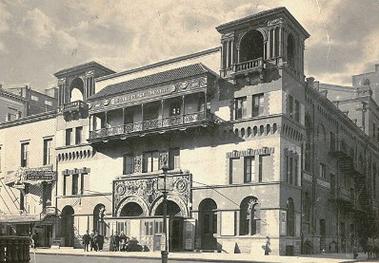
| | | | | | But first, as an aside: I was curious about the neighborhood being a theatrical center, and was surprised and pleased to find this nearby: the Irving Place Theatre, on the SW corner of Irving Place and 15th Street (see map), just a short block from Lüchow's, built in 1888 as Ambergs Deutsches Schauspielhaus (Amberg's German Theater), and renamed to the Irving Place Theatre in 1893.
https://blogger.googleusercontent.com/img/b/R29vZ2xl/AVvXsEib5OsS4TstZXOXystQTeu15UMzNW_Av_lycr8NWCPBWTPprBNmaTScLrzLUmvkp4wM1c3jTcycqjHLrqxtI5rRK_iQo3EL5_9xOUv77NJLVw8nQRpdnbuwtarysAGLJryaND2wfMQhcyunGbODc7xudt5JUJGlZ-lU8S7__iBSfgfXFvvECpWdY8bA/s1024/irving%20place%20theatre%20playbills%201907.jpg
This would have been a major cultural venue in Kleindeutschland. However, in 1918, as the neighborhood changed ethnically to be known as the Lower East Side, the facility became the home of the Yiddish Art Theater company. By the 1920s burlesque shows were offered alongside Yiddish drama (!!). It was converted to a warehouse for the S. Klein department store on Union Square c1962, and demolished in 1984 to make way for the Zeckendorf Towers development.
|
| | | | Back to Lüchow's, at 110 East 14th, facing north to Irving place, showing its façade c 1902. The restaurant eventually expanded thru south to 13th Street.
It was a jewel of Kleindeutschland, tho I didn't realize that during the few times Beverly and I dined there after we got married. Like nearby Joe King's it just seemed to us to be a stand-alone famous site.
Again, you'll find a summary on the older posting, but I've happily found more now to add to it. Lüchow's had been the quintessential German restaurant and dominated the celebrity dining scene from 1882 until the 1970s. Irving Place opposite was the center for the arts in New York at that time. Generations of musicians, writers, actors, politicians, and financiers were regular patrons, such luminaries as O. Henry, H.L. Mencken, Lillian Russell, Diamond Jim Brady, Theodore Roosevelt, Paderewski, Caruso, Richard Strauss, Victor Herbert, Irving Berlin, Richard Rogers, and others. ASCAP, the American Society of Composers, Authors and Publishers, was organized there. At that time the stretch of 14th Street extending crosstown on either side of Union Square was at the heart of the most prestigious part of the city, and August Lüchow's new establishment quickly became known as "the capital of 14th Street". It was a restaurant devoted to good living, described as having "epic Teutonic dining" with Baroque elegance.
This is a postcard view of Lüchow's plush interior. There was a number of rooms, one decorated with Tiffany glass. The postcard shows the view from the "Café" into the "Garden", so called because it had been a Biergarten on 13th Street which was later enclosed. Lüchow's had become the agent for Würzburger beer, and the open beer garden allowed for beer delivery around the city. In the main dining room and private rooms only fine wines and beer were served. Those who wished to have hard liquor were served in the Gentlemen’s Grille, a separate room on the same floor.
In 1882, August Lüchow from Hannover was working as a bartender and waiter in a previous restaurant on the same site. A regular customer there was the distinguished piano magnate William Steinway (born Wilhelm Steinweg, near Goslar), whose 1866 concert hall, Steinway Hall, was across the street and a block away at Union Square, at the northeast corner of what is now Union Square East and 14th Street. (see map).
| | | | | | Steinway Hall lasted as such until into the early 20C. At about that time, it was replaced by the low-cost S Klein department store, which in turn was replaced by Zeckendorf Towers, mentioned above with the replacement of the Theater on Irving Place. |
| | | | Lüchow was able to purchase the business with the help of a $1500 loan from Steinway, who therefore has been called the "patron saint" of Lüchow's. Steinway would eat lunch at an upstairs room regularly at noon with senior executives from his firm. The forty-five-cent lunch, which began with 12 oysters, could last as long as three hours.
We have to talk about the name. We know the Ü is a unique sound to German, French, Dutch, and surely others, an I as in "police", but with lip rounding. The CH is as in "ich", sort of a Y with breath. The W, as in other North German names (Pankow, Bülow) is often described as "silent", but that's nonsense; it actually lengthens the previous vowel, so OW is like OH. However, these niceties are lost on the Anglo public, and the name was always pronounced like "Lou"+"chow", like you're about to "chow down" on dinner. However, there's a problem there. Say it that way, which was standard in NYC, and it sounds Chinese! Thus many uninformed people thought Lüchow's served Chinese food, and I must admit, before Beverly and I dined there the first time of our 2-3 times, so did I!
But visually speaking, what stands out in the written form is the umlaut over the U. August Lüchow always spelled the restaurant's name correctly until 1917, when the US entered WWI. He then altered the spelling to Luchow because of anti-German prejudice at the time. The spelling didn't go back to Lüchow until 1950. Thus the Times on 6 September 1952 ran the punning headline "Umlaut Spells Difference in Chow on 14th Street", stating that the umlaut "spells all the difference between an old-fashioned German restaurant and a chop suey palace."
Esther Crain, in an article in her website "Ephemeral New York" dated 23 January 2009 stated: "I’m not aware of any New York City eatery with an umlaut in its name. But for a century, there was Lüchow’s." That was perfectly true when she wrote it, but I checked about today, and find there is a Döner Haus. And it gets weirder. Döner Haus has an outlet one block east of the Lüchow's site, on the other side of 3rd Avenue, also on the south side. You may know that döner kebab is a Turkish dish made of seasoned meat cooked on a vertical rotisserie, served with pita. In NYC it's also referred to as Greek gyros or Arab shawarma. The modern sandwich version originated and was popularized in the 1970s in West Berlin by Turkish immigrants, mostly descendants of the Gastarbeiter (guest worker) programs from that period. So döner are today just as German as anything else. Thus it's particularly weird that Lüchow's served traditional German cuisine while the Döner Haus adds a more contemporary version.
The neighborhood declined, and was no longer part of the theater district. Lüchow's was surrounded by empty buildings. There was little left in the neighborhood to attract the type of clientele that Lüchow's was intended to appeal to. A suspicious fire in 1982 destroyed the building. New owners moved Lüchow's to a dreary below-ground-level location on Broadway at 51st--and dropped the umlaut again—but that also closed in 1986. And an era was over.
| | | | Jux Before we leave 14th Street to go Uptown, it's worth adding something I think is quite unexpected, but that fits here. In 1842, the Austrian dramatist Johann Nestroy wrote a very popular "farce with singing" called Einen Jux will er sich machen (He Wants to go on a Spree / He Wants to Have a Good Time). (For Jux, J=Y; it rhymes with "hooks".) It involved Zangler, a spice trader in a small town, along with Weinberl, his senior clerk, played by Nestroy himself in the original, and Christopherl, his junior clerk. (To indicate the Austrian flavoring to the play, note that the typical Austrian diminutive –ERL appears at the end of the two boys' names.)
https://m.media-amazon.com/images/I/71vQK9VdHLL._SL1200_.jpg
Jump ahead to 1938, when Thornton Wilder ("Our Town") adapts the play radically. He moves the time period up six decades to the turn of the 20C. He moves the location to suburban Yonkers and New York City. Zangler becomes Horace Vandergelder, and the play is renamed after him as The Merchant of Yonkers. The two boys become Cornelius and Barnaby, and, most significantly, a new character is introduced, the matchmaker Dolly Gallagher Levi. But the play flops after only 39 performances.
https://assets.playbill.com/playbill-covers/_embeddedGallerySize/8b9aaf890d611bc6c2f0737e99d43846-the-matchmaker-playbill-1956-07-web.jpg
So back to the drawing board. Wilder rewrites the play, expanding the role of his new character, Dolly Levi, and, most significantly, centering it on her, renaming the play The Matchmaker. Cornelius and Barnaby (even Vandergelder) are moved to secondary characters, tho still important. It opens in 1954, to much more success. But that's not the end.
David Merrick, who had produced The Matchmaker, in 1964 partners with composer Jerry Herman to mount the hugely successful, Tony Award-winning musical version of The Matchmaker, Hello, Dolly! (exclamation point included), starring Carol Channing. I never saw Channing in Dolly on Broadway, but I did see her do it later on tour in Tampa. I saw Bette Midler do her Tony-winning version on Broadway sometime in 2017-8.
So what does all that have to do with Kleindeutschland, 14th Street, and Lüchow's? At the turn of the 20C, NYC's entertainment world was 14th Street, and, tho Kleindeutschland is never mentioned, that's just where the culmination of Hello, Dolly! takes place. Vandergelder travels to the city to participate in the fictitious "Fourteenth Street Association Parade", and Dolly sings specifically of returning to "the lights of 14th Street". Her big appearance is her main entrance at the fictitious Harmonia Gardens restaurant, with its chandeliers, wall mirrors, and tuxedoed waiters. Is there any doubt that the Harmonia Gardens is Lüchow's in disguise, tho that name is never mentioned? And the head waiter is named Rudolph Reisenweber, a name that adds to the ambiance of the restaurant and to the German connection.
| | | | Yorkville It had never really struck me that Kleindeutschland led directly to German Yorkville. We have to consider that two-word phrase a retronym, because it appeared only after the area became simply Yorkville. Saying "German Yorkville" for much of the 19C and early 20C would have been as redundant as saying "Italian Little Italy", because Yorkville was already understood to be German. And now it, like Kleindeutschland, it's gone.
https://i.pinimg.com/736x/63/a0/54/63a05446d9787a236d1ae3f6c378bcdb.jpg
The name Yorkville dates back to the 1830s when the Yorkville Post Office and Police Precinct were established along the Old Boston Post Road, in a section now called Third Avenue (see map). The area was named for its location north of nearby York Hill, which was east of Park Avenue. From 1880, Yorkville became a destination for German-born immigrants, mostly middle- and working-class families. Then, by the 1900s, many German residents moved to Yorkville (and other neighborhoods) from Kleindeutschland after the General Slocum disaster in 1904. The ship caught fire in the East River just off East 97th Street in Yorkville (off the upper right of the map), leading family members to want to move closer to the site of the incident.
Again, the posting 2019/3 gives the details, which will just be supplemented here. One of us in our dining circle wrote about his visiting Yorkville in his school days, as did I. I also remember taking a group of my German students from John Jay HS in Westchester, including Carter Brey, along with Beverly taking a group of hers from neighboring Fox Lane HS, to dinner in Yorkville (after walking around) in the early 1970s. I'd forgotten which restaurant we'd chosen and Carter reminded me we went to the Heidelberg. He remembered he had the Königsberger Klopse, which I once had catered at a Fest at my place, and which the Heidelberg no longer serves.
I am startled to find that memory is not all that accurate. I've been sure that atmospheric German Yorkville extended on 86th from Central Park to the East River (see map), and that was NOT the case. In reality, the sights to see were concentrated on the eastern end, and—I'm shocked—within the one block between 2nd and 3rd Avenues, the "200" block, mostly on the south side! That's literally just around the corner from the Heidelberg on 2nd, indicating how close to each other all these venues were.
https://i.pinimg.com/originals/a9/9a/b4/a99ab4560649775b325e2ec16b7f2a4d.jpg
The above photo shows the Kleine Konditorei at 236 E 86 next to the Bavarian Inn at 232. [NB: a Konditor is a pastry chef working in a kon.di.tor.EI, or pastry shop (like a French pâtisserie)—so the name is the Little Pastry Shop.] The Bavarian Inn was there from 1933 to 1983.
https://i.pinimg.com/originals/95/1b/1d/951b1d65f5f2d545db4021be88bcc9d1.jpg
https://i.pinimg.com/474x/16/44/30/164430dfc9b13e89b6d8900fd1de0a19.jpg
The Café Geiger was adjacent at 206. It used the C spelling of Conditorei. At 200 was the Bremen House, which sold tourist schlock like beer steins and cuckoo clocks, but we can forgive that. Also, facing on the north side of the street were the Lorelei at 233 and Platzl at 225.
https://cdn.vox-cdn.com/thumbor/mMbJ54g-5Uzd95DstwN-7zTCcpA=/0x0:869x577/1200x0/filters:focal(0x0:869x577)/cdn.vox-cdn.com/uploads/chorus_asset/file/4069116/hedelberg.0.jpg
The Heidelberg, dating from 1939, the year I was born, is just around the corner on 2nd Avenue, east side, just steps from 86th. It owns the 1937 Schaller & Weber deli to its left. I recently hosted dinner for our dining group, which sat just on the other side of that right-hand triple window. This photo has a quirk. Along with the American flag, that isn't the German flag. The city of Heidelberg is in Baden-Württemberg, and it isn't that flag, either. The blue-and-white lozenge flag is that of Bavaria. Why?
https://media.gettyimages.com/id/97939958/photo/yorkville-casino-at-210-e-86th-street.jpg?s=1024x1024&w=gi&k=20&c=4rx6MaFqo9K-QpEIJsKVlViuQgFN8Vcx52A_9FKPEKo=
https://media.gettyimages.com/id/515619520/photo/workman-removes-german-posters-and-signs-describing-german-movie-from-the-casino-theatre-in.jpg?s=612x612&w=gi&k=20&c=52wm76zutJAw99oP4ytq1R3ErUA3ajafnyWXGx8MWtg=
https://i.ebayimg.com/images/g/2p4AAOSwRqpnbWe4/s-l400.jpg
Back to that same 200 block around the corner. I remember back in the day going several times to a cinema showing German films, and now know more about that venue. The Yorkville Casino was built in 1904 at 210 E 86th, apparently as a community center. It included a cabaret, two main ballrooms, and a movie theater. In 1964, it was announced that the Yorkville Casino would be repurposed and made into an office building with a movie theater downstairs, so this was the Casino Theater I remember (first photo link). Note the second photo. "Jetzt Spielend" is an anglicization, translating "Now Playing". In Germany and Austria it might say "Es spielt jetzt . . ." or "Jetzt im Kino . . ." Notice the film on the sign: "Liebe im Dreiviertel-Takt" (Love in Three-Quarter Time), a 1937 film with Leo Slezak, for which I've found an illustration.
https://loving-newyork.com/wp-content/uploads/2019/09/steuben-parade-new-york-route-map.jpg
https://media-cdn.tripadvisor.com/media/attractions-splice-spp-720x480/0c/0b/74/e6.jpg
https://germanparadenyc.org/wp-content/uploads/2018/09/DSC_6286-1024x678.jpg
And then there's the Steuben Parade (route map above). As that earlier posting points out, there are many ethnic parades in NYC. Most famous is the Saint Patrick's Day Parade that runs south on Fifth Avenue. However, in 1957, the first official German-American Steuben Parade was held in Yorkville (see photo with horses, and an actual German flag in the center). From the beginning the Parade marched NORTH on Fifth with a then obvious destination. It turned right on 86th, and marched along it down to Second Avenue. While similar parades take place across the US, the NYC parade draws the largest crowds. Some years ago I attended it, the only parade I've ever gone to in Manhattan.
Today, the parade still takes place on the third Saturday in September. This year it will be on Saturday, 19 September 2026. Sadly, while it continues to go up Fifth Avenue (in the last photo, passing by the Metropolitan Museum of Art on 82nd), it ends at 86th Street (symbolically?) but has no reason to turn down that street. It's led by cadets representing the German Language Club of the Military Academy of West Point, founded by General von Steuben himself. The three-hour parade is filled with German groups wearing their traditional costumes, spectacular floats, marching bands, dancers, clubs, and organizations from across the US, Canada, Germany, Austria, and Switzerland. Given its late date, in some sense it melds into an Oktoberfest-style beer fest complete with food and live music in Central Park.
| | | | Aberystwyth The posting of 2008/17 covered a few things, the last being some fun limericks. If you want to review that, you'll find my favorite one by doing a Ctrl-F: plumber
I mention that because I've come across another one online that I'd like to add to this posting as an unrelated coda. It involves a Welsh place name that at first looks unpronounceable, maybe because of the two Ys. I've driven thru Aberystwyth on the coast of Wales, but never had a reason to stop there.
I now learn that the name means "the mouth of the Ystwyth", which is a minor river, just 33.0 km (20.5 mi) long. Thus Welsh Aberystwyth is just like English towns at river mouths, such as Plymouth, Dartmouth, Exmouth, Falmouth, Bournemouth, and others.
The name Aberystwyth is four syllables long: a.bə.RIST.with, and that's how it's used in the original version of the limerick, where it's a little long.
You can read the limerick with the original four syllables, but I find it smoother to bring it down to three, just for this limerick, by dropping the schwa (ə) and losing its syllable: a.B'RIST.with, now respelled: Ab'ristiwith. Here's the limerick:
There was a young girl of Ab'rystwyth,
Who took grain to the mill to get grist with.
The miller’s son, Jack,
Laid her flat on her back,
And united the organs they pissed with.
I find it very clever, and was surprised to find that, while most limericks seem to be anonymous, this one was written by the English poet, playwright, novelist, and critic, Algernon Charles Swinburne (1837 – 1909). Swinburne's work attracted scandal, but had Victorian defenders. His work influenced others at the turn of the 20C, including Oscar Wilde. He was nominated for the Nobel Prize in Literature every year from 1903 to 1909.
I find it most interesting that, after the death of Alfred, Lord Tennyson in 1892, Swinburne was considered for the post of Poet Laureate of the United Kingdom. Yet he was disqualified by none other than Queen Victoria, specifically on moral grounds. This shows why, in the Victorian era, following Queen Victoria, people probably didn't have as much fun as they could have.
| | | |
| |
|
|
|